 Why Replacing a Garage Door in Milford Isn't a One-Size Job
Milford homes built mostly between 1954 and 1986 often have garage openings sized for older standards and thin insulation - know this before replacing yours.
BlogMilford, CT · 4 min read
Why Milford's Older Housing Stock Loses Springs in a Cold Snap
Milford homes built mostly between 1954 and 1986 have torsion springs that fail more often in sharp cold snaps. Here's what to watch and what to skip.
Local detail
How Local Conditions Play In
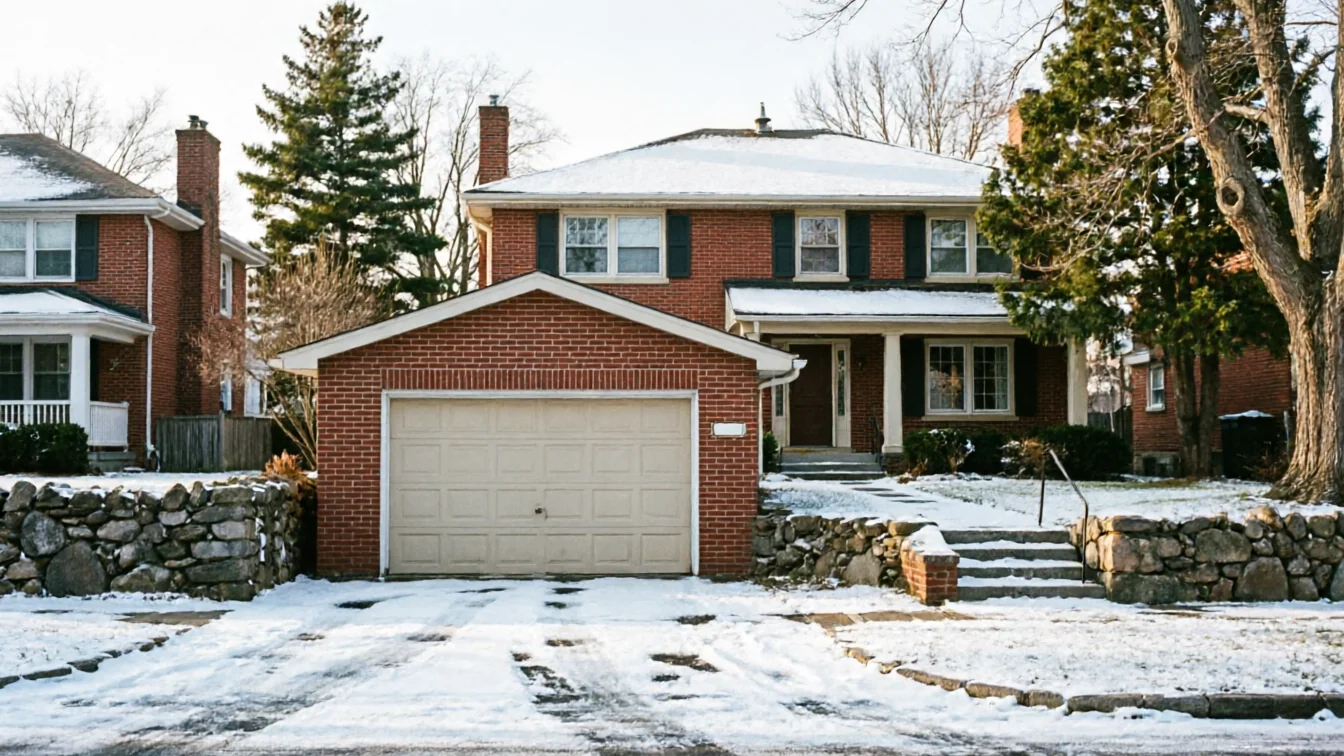
Most houses on this side of the shoreline went up between 1954 and 1986, with the median build year sitting around 1971. That matters here because the torsion springs on a door that age were wound for a cycle life, not for forty-plus winters of expansion and contraction. Milford sits in a cold-climate band with real severity, not just occasional frost - steel that's already near the end of its rated cycles gets brittle fast when the mercury drops and stays down. A spring that's been coiling and uncoiling since the Nixon or Carter years doesn't need much of a cold snap to finally let go. We see this pattern across the 1960s-and-70s housing stock that makes up most of the town: the door opens fine in October, then a January morning comes along and the spring snaps clean, usually on the first lift of the day when the metal is coldest and tightest. It's not bad luck. It's decades of thermal cycling meeting one more cold morning the spring just can't absorb.
The area
Where People Go Wrong
The biggest mistake is assuming a spring from a house built in this era is interchangeable with whatever the big-box store has in stock. Doors from the 1960s and 70s were often matched to a specific spring wind and wire gauge for that door's weight, and swapping in a generic replacement without checking the original spec leaves you with a door that's hard to lift by hand or slams down fast - both of which get worse, not better, in cold weather. The second mistake is waiting for warm weather to deal with a spring that's already making noise. Cold is when a weak spring fails, so putting off the call until spring (the season) means risking the failure during the exact months it's most likely to happen. People also lubricate the opener chain and skip the spring coils entirely, when the coils are the part under the most stress through a cold winter. None of this is exotic knowledge - it's just easy to skip when the door is still opening, until the morning it isn't.
What we find
Leaving It Alone
A spring that's visibly stretched, has a gap in a coil, or makes a grinding or popping sound on a cold morning is not a wait-and-see situation. Torsion springs store a lot of tension, and one that lets go while the door is up, or while someone is standing under it, can drop a heavy panel fast. We won't tell you every noisy spring needs same-day replacement - sometimes it's a track alignment issue or a dry roller, and a spring that's simply old but intact can run another season. But once a coil shows separation or rust pitting on a house built in this 1954-to-1986 window, the honest call is to replace it before the next hard freeze, not after it snaps. Leaving a visibly failing spring alone through a Milford winter is the one shortcut that tends to cost the most, because it usually ends with a stuck door, a dead opener motor from straining against a broken spring, or a service call on the coldest day of the year when everyone else is calling too.
How we work
The Problem
Steel contracts in the cold, and a torsion spring that's already fatigued from a few thousand open-close cycles has less give left to work with. On a house from this era - built sometime in that 1954-to-1986 stretch, median right around 1971 - the spring has likely been through more winters than it was rated for, even if nobody's ever had a reason to look at it. Cold makes the metal stiffer and more prone to fracture right at a stress point, usually where the coil was wound tightest at the factory. That's why the break tends to happen on the first cold lift of the morning rather than mid-afternoon once things have warmed a degree or two. It's a mechanical fact of the material, not a defect in any one door, and it's consistent across the older torsion setups common in this part of the state. The honest limit here is that we can't predict exactly which morning a given spring will go - only that age plus sustained cold raises the odds a lot.
Questions
Common questions
Why do garage door springs seem to break more in winter in Milford?
Cold steel is more brittle, and a lot of the torsion springs in town are original or near-original to houses built between 1954 and 1986. That's decades of open-close cycles on metal that's already stiffer from the cold. The first lift of a frigid morning is when the stress hits hardest, which is why breaks cluster on cold snaps rather than spreading evenly through the year.
If one spring breaks on my two-spring door, can I just replace that one?
You can, but on a door this old we'd rather not. If one spring has fatigued and failed, the other has usually been through the identical number of cycles and the same winters, so it's not far behind. Replacing just one often means a second call within a year or two, which costs more in the end than doing both now.
Is there a way to tell a spring is close to failing before it snaps?
Visible gaps between coils, rust pitting on the coil itself, or a grinding or popping noise on a cold start are the signs worth acting on. A spring that's simply old but shows none of that can often run another season. One that's showing wear on a house from the 1960s or 70s shouldn't wait for a hard freeze to prove the point.
Recommendation
You Might Also Like
More garage door guides for Milford homeowners.
Why Replacing a Garage Door in Milford Isn't a One-Size Job
Milford homes built mostly between 1954 and 1986 often have garage openings sized for older standards and thin insulation - know this before replacing yours.
 What That Grinding, Popping, or Banging Sound Actually Means
Milford homes built mostly between 1954 and 1986 have original garage hardware that grinds, pops, or slams in cold weather - here's what each sound means.
 What Milford's Older Housing Stock Means for Your Garage Door
Milford's housing stock mostly dates to the 1960s and 70s, built before insulation codes existed.
Ready when you are
Need a garage door sorted in Milford?
Milford Garage Door Pros repairs and installs garage doors, springs and openers in Milford, CT and the surrounding area.